
Alternative Investment Funds (AIF) are another investment vehicle for High Net Worth Individuals (HNIs) with minimum investment amount for most AIFs being 1 Crore INR . Different types of AIFs are meant for different types of investments and has different Tax treatments.
AIFs mostly use Pooled Money from investors to invest in certain types of investments. For many such fund, Money can be invested over 1-2 years, not just in one shot, which might help many investors to arrange money at different interval (such as yearly salary bonus etc.).
It has highest flexibility in terms of type investments compared to Mutual Fund or PMS and regulated by SEBI (e,g, Listed Stocks, Derivatives such as Futures and Options, Real Estate, Unlisted Stocks , Angel Funds for Startups etc.).
AIF Types and their Objective/Risks and Taxation
Category I AIFs:
These funds invest in SMEs, start-ups, and new economically viable businesses with high growth potential. Examples: Angel Fund, VC Funds, Infrastructure Funds, Social Venture Funds. In terms of Taxation, just like PMS, all the Gains and Losses are taxed directly in the hands of investor.
Category II AIFs:
These could be Private Equity funds investing in unlisted stocks. It also could be a Debt Funds investing in complex corporate investments. It could also be just a Fund of Fund investing in various other types of AIF Funds. They can also invest in Real Estates and other distressed assets. Taxation is same as Category I AIF.
Category III AIFs:
These fund use complex trading strategies including Leveraged trading, Derivatives (Futures and Option)etc. These could also be Private Investment in Publicly listed stocks and Hedge Funds. In terms of Taxation, all the income (Business Income, Dividends, Capital Gains) are taxed at Fund Level. Long Short funds , Hedge Funds are this category AIFs.
This type of AIF is not suitable for NRIs/OCIs from Europe/Australia, US/Canada etc., where they have to declare the global income. Since for this type of fund tax is paid inside the fund, not in the name of investor, such investors cannot take advantage of Dual Taxation treaties, rather they would have to pay separate tax on top of taxes paid by the Fund directly.
AIF Investment Split
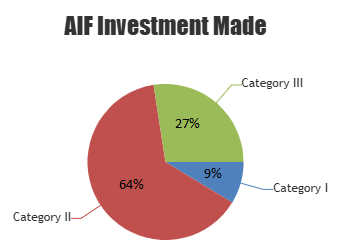
As per SEBI Data (as of 30 Sep 2024), following are the percentage split of the AIF investments in India.
CRISIL AIF Benchmarks
CRISIL (Renowned Global Rating and benchmarking agency) has created Benchmarks for different AIF types. Each of the AIF fund’s return/risk/volatility etc. could be checked compared to these benchmarks
| Category I | Category II | Category III |
|---|---|---|
| – Venture capital funds – Social Venture funds – SME Funds | – Equity funds – Unlisted – Equity funds – Listed + Unlisted – Real estate funds – Real estate funds – Residential – Real Estate Funds – Residential (debt- oriented) – Debt funds – Distressed asset funds | – Long-only Equity Funds – Long-only Equity Funds (open-ended) – Long-only Equity funds (closed-end) – Long-short Equity Funds – Hybrid funds |
Why to invest in AIF since PMS already caters to HNIs
AIF investment amount in India has passed 4 Lakh Crores of investment as of 2024. However, one might wonder why to invest in AIF funds, when PMS is taking care of managing investment portfolio for HNIs. Equity based PMS are restricted to invest primarily in listed securities without any leverage. Hence, PMS portfolio also goes through Bull and Bear cycle along with the stock market.
However, HNIs and Ultra HNIs with multi-crore portfolio might want to diversify their portfolio with various other techniques and instruments along with listed stocks such as Leveraged trading, Derivatives (F&O), Unlisted Companies, Debt instruments like convertible debentures, Real Estate, Large infrastructure projects etc. (Leveraged trading means investing more amount in stocks than available cash through borrowing to multiply returns). Suitability of specific AIF fund depends on the Fund objective and where the investor wants to invest along with risk appetite and taxation related considerations. Category III AIFs use similar instruments as PMS, but they can have lot more flexibility and allowed to use complex techniques to increase the return or and increase the stability of the fund.
Category I and Category II AIFs are Closed Ended funds with minimum 3 years of lock-in, whereas Category III funds are mostly Open Ended funds. This arrangement in Cat I & II funds provides high flexibility to the Fund Managers to look at long term gains, without worrying much about any short term volatility, market sentiment etc.
Some AIF funds invest in future opportunities, which are not discovered easily by others, hence allows the long term investors to get the benefit of early detection of large undiscovered opportunities
AIF Summary
AIF provide variety of investment opportunities, unlike only listed stocks (in case of PMS). Many AIFs are closed ended funds with some maturity period. However, PMS provides more transparent visibility into the investments done. AIFs are mostly suitable to HNIs, who has already invested in Stock market through PMS and Mutual Funds and would like to diversify portfolio with different types of private investments or mix of private and secondary market investments. AIFs are also suitable for traditional HNI investors, who would like to get high return even from Debt instruments (much more than Fixed Deposits), make Proxy Real Estate Investment etc.
 India Investment Corner