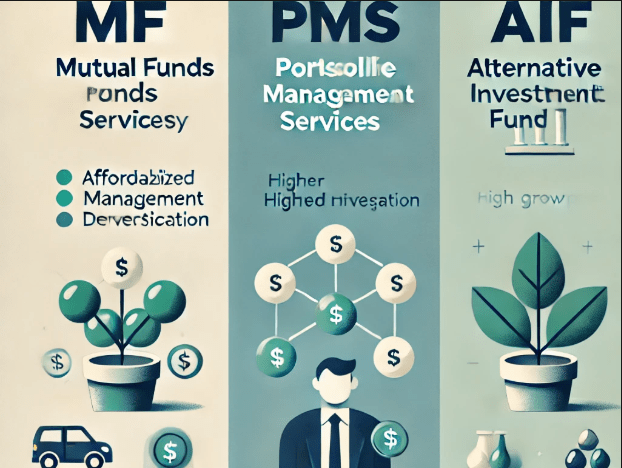
Mutual Funds are very tax efficient Retail Investment product. It provides options to invest in multiple asset classes like Debt/Bonds(similar to FD), Equity (Stocks) as well as Commodities (Gold/Silver). This industry has evolved in past two decades and has products suitable for every type of investors (Any age group : Young/Middle Age/Retirees; Any risk appetite : Conservative, Moderate, Aggressive; Any investment amount : Few thousands , Few lakhs to few Crores). In a nutshell, Mutual Funds are types of investment, which is absolute must for every type of investor, at least for a recurring monthly investment through SIPs.
However, Mutual Funds have some drawbacks. It is highly restricted by regulations, it can only operate within the Fund Category Mandate set by SEBI (e,g, a Largecap MF would have to invest at least 80% in Largecap Stocks). Moreover, all Equity Mutual Funds must have at least 65% of their investment in Stocks at all point of time, irrespective of market conditions. Also, most Midcap/Smallcap Mutual Funds with high Asset Under Management (AUM), would find it difficult to fast exit from certain stocks due to liquidity issues (not enough buyers available etc.)
Portfolio Management Service (PMS) is a product meant for Moderate to High Networth investors with minimum investment capital being 50 Lakhs INR. Unlike Mutual Funds, PMS directly operates with investors DEMAT account and buy/sell stocks in the investor’s DEMAT on behalf for the investor. Also, most PMS strategies have much lesser AUMs compared to Mutual Funds. Additionally, they operate on much flexible mandate. They can sell all stocks and go to full cash in no time, if the market situation demands that, such drastic changes are very difficult/impossible for Mutual Funds.
These flexibilities allow prudent PMS portfolio Managers to navigate the volatilities very fast and provides better downside protection. Additional advantage of PMS is it can offer personalization of the portfolio in some cases and also access to the Portfolio Managers to understand their strategies and investment thought process more. Moreover, PMS are the most transparent type of investments which allows investors to see the performance of the stocks which they hold and the new buy/sell decisions on daily/weekly basis. However, PMS are little tax inefficient compared to Mutual fund as all the Buy/Sell of stocks happen directly in the investor’s DEMAT account.
Alternative Investment Fund (AIF) on the other hand provides various boutique investment options for High Net worth Investors, with 1 Crore INR as minimum investment amount. AIF investments are much more that just investing into Stocks or Debt/Bonds. It can invest in complex Derivative Trading, it can do leveraged investment ( e,g, with 100% leverage a Fund can invest in 2 Crore assets with 1 Crore capital investment), Investing into unlisted companies, Private Equity, Venture Fund, Hedge fund, Infrastructure Fund investment etc.
These options allow AIFs to provide better long term Risk Adjusted return compared to the equivalent investment options in the Mutual Fund (e,g, some Debt type AIFs, could provide much higher returns from Debt Mutual funds and even higher returns compared to Bank Fixed Deposits. Similarly, some Long Short AIF funds provide much higher returns compared to Arbitrage Mutual Funds. Other AIF investment types don’t even have their equivalents in Mutual Funds (such as investment in Private Equity, Angel Funds etc.). However, AIFs are not very liquid as most of the AIFs are closed ended in nature with certain maturity periods.
Practical Investment Options for various Networth Investors
Investors with 50 lakhs Investment capital
In this case, the choice is limited to Mutual Funds primarily along with Bank Fixed Deposits and some direct stock investments. For stock investments, there are stock advisory services provided by many brokers/financial institutions, prominent one being Smallcase . More details on Mutual Fund vs Smallcase investment is provided HERE
Investors up to 2-3 Crore Investment Capital
Such investors could look at putting some part of their investment in PMS and some part in Mutual Funds based on their risk profile along with monthly SIP to Mutual Fund to continuously grow the investment capital.
However, Risk Averse investors, who are not so much comfortable with the volatility of Stock Market, could look at AIF options related to Debt, Long Short funds, which are much lesser volatile compared to direct stock investments through PMS.
Investor with 3 Cores and above investment Capital
These investors with moderate to high risk appetite, could invest in AIF, PMS and MFs all together. This allows for higher diversification of investment types and instruments. Monthly SIPs can help in continuously growing the investment capital. These class of investors could benefit from the all the investment horizon available in the market and maximize Risk adjusted Returns.
Note: Many HNI investors invest in global stock markets also directly for diversification. The investment capital mentioned here is considering only the amount, which is meant for investment in India. Also, direct Real Estate investments are not considered here as we feel Real Estate as investment is not a great long term investment, rather individuals should buy Real estate for their own use.
 India Investment Corner