You may be knowing many Retirees in your known circle or even in your family who doesn’t get any pension from Govt. or Company or any other kind of private pension, or may be getting some private pension, which is not able to take care of their basic monthly expense. However, they may have some corpus amount (e,g, 10-50…. lakhs)saved for Retirement. In most cases, what is observed is most such retirees put this corpus amount in Bank Fixed Deposits, which gives very meagerly returns (Monthly/Quarterly payouts), also the payout amount don’t change yearly. Hence, after few years it becomes very challenging to live the life at the same levels due to yearly inflation, increase of prices of items for daily use.
So, how do we help such Retirees to get meaningful monthly payout and also grow the payout every year and still allow them to have the payouts forever along with continuously growing the corpus even during this period. Primary solution is to bring in some amount of Equity investment in their portfolio along with Fixed Income assets. This can be easily done by investing the corpus in one or two EQUITY SAVINGS Mutual Fund schemes, which is a type of Hybrid Mutual Fund, typically invests 30-40% of corpus in Equity (Stocks) and remaining amount in Debt instruments like Bonds etc. The risk involved in Equity Savings Mutual Fund is little more than Fixed Deposit, but for muti-decade investment period, that much risk doesn’t matter much. As of end of 2024, 10 years returns for many funds of this category is around ~9.5% (with much higher returns during past 3-5 years period) , which is significantly higher than 6-7% Bank Fixed Deposits return during this period.
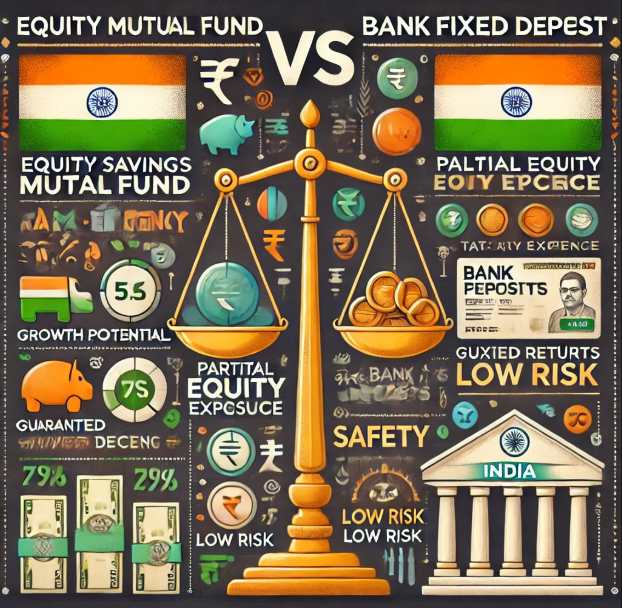
Illustration – Bank Fixed Deposit vs Equity Savings Mutual Fund
Now considering the 7.5% return/payout for Fixed Deposit vs 9.5% in Equity Savings Mutual Fund with 50 Lakhs Corpus , let’s see how the payout works for every year and what happens to the corpus after few years.
| Year | FD monthly Payout (7%) | FD end of year corpus amount (No increase in Corpus as full return is payed out) | MF Monthly Payout (8%) | MF end of year corpus amount (increases by 1.5% after 8% payout, with total yearly return being 9.5%) |
| Year -1 | 29,166 | 50,00,000 | 33,333 | 50,75,000 |
| Year -2 | 29,166 | 50,00,000 | 33,833 | 51,51,125 |
| Year -3 | 29,166 | 50,00,000 | 34,341 | 52,28,392 |
| Year -4 | 29,166 | 50,00,000 | 34,856 | 53,06,818 |
| Year -5 | 29,166 | 50,00,000 | 35,379 | 53,86,420 |
| Year -6 | 29,166 | 50,00,000 | 35,909 | 54,67,216 |
| Year -7 | 29,166 | 50,00,000 | 36,448 | 55,49,225 |
| Year -8 | 29,166 | 50,00,000 | 36,995 | 56,32,463 |
| Year -9 | 29,166 | 50,00,000 | 37,549 | 57,16,950 |
| Year -10 | 29,166 | 50,00,000 | 38,113 | 58,02,704 |
Note: for simplicity purpose, it is assumed that Equity Savings MF would provide same return every year, in reality would be more of less every year. These variations might impact the end of the year Corpus little bit. For Mutual Fund payout, SWP (Systematic Withdrawal Plan) for fixes amount is assumed.
As you can see in this illustration, in case of Bank Fixed Deposits the corpus doesn’t increase, hence there is no increase in payout every year, but that is possible for Mutual Fund. Also, the overall monthly payout is much higher in few years in case of Mutual Funds.
Equity Savings Mutual Fund Examples
As of end of 2024, following are the Historical returns from few of the Top performing Equity Savings Mutual Funds (Regular Plans).
| Scheme Name | 3 years Return | 5 Years Return | 10 Years Return |
| HSBC Equity Savings Fund – Growth | 14.23% | 13.68% | 9.48% |
| Sundaram Equity Savings Fund – Growth Accumulation Plan | 11.34% | 12.80% | 9.44% |
| Mirae Asset Equity Savings Fund – Growth | 10.21% | 11.54% | – |
| SBI Equity Savings Fund – Growth | 11.11% | 11.30% | – |
| HDFC Equity Savings Fund – Growth | 10.75% | 11.16% | 9.45% |
| Kotak Equity Savings Fund – Growth | 11.83% | 11.07% | 9.44% |
| UTI Equity Savings Fund – Growth | 10.78% | 10.95% | – |
| Mahindra Manulife Equity Savings Fund – Growth | 8.96% | 10.79% | – |
| Edelweiss Equity Savings Fund – Growth | 9.87% | 10.58% | 8.85% |
Conclusion
Equity Savings Mutual Fund are excellent choice for the Retirees, who would like to get a continuous monthly income to take care of their basic financial needs at the same time grow the corpus to get better inflation adjusted monthly income in future years. Many retirees didn’t understand the effect of inflation in their monthly financial need and fall into the trap of Fixed Deposit income. This might look sufficient for initial few years, but becomes unsustainable after few years.
 India Investment Corner