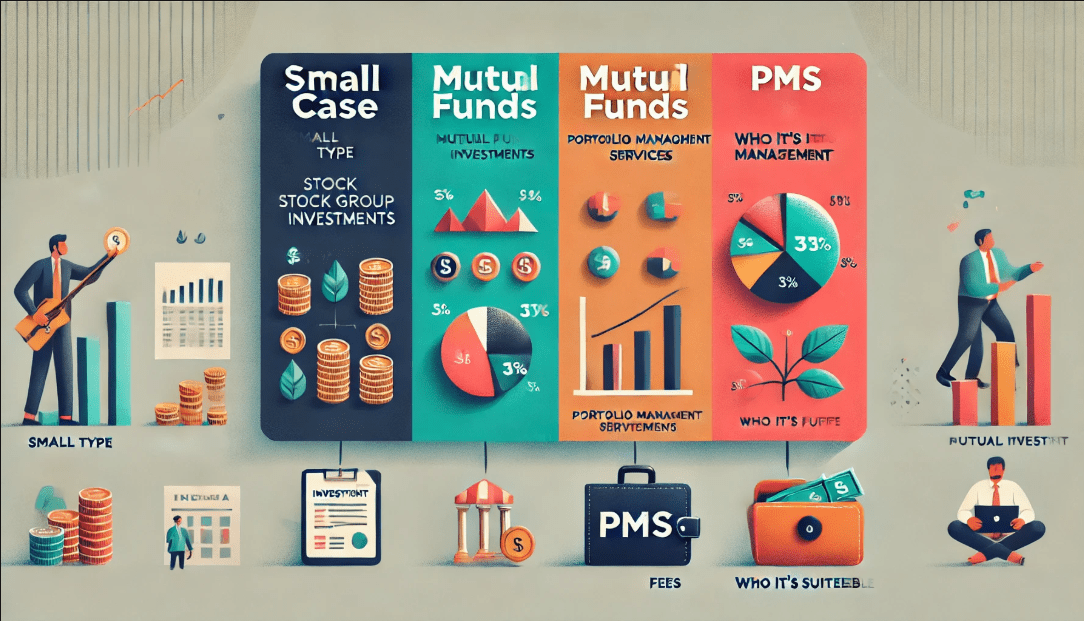
With the advent of Smallcase investment in 2016, Retail Investors found another way of investing in Stock Market. In general it is not so easy to pick the right stocks in a volatile stock market for a retail investor as the individual stock investment decisions needs lots of experience in careful observation of the fundamentals of the stock and its it’s future growth projection.
With Smallcase, such retail investors starts getting professional advice on building direct stock portfolios with a small fees (often it is fixed fees only).With the growth of retail participation in the stock market through ease of opening DEMAT accounts along with the growth of low cost Brokerage houses, Smallcase portfolio numbers have grown significantly over the years. As of 2024, there are 500+ Smallcase Portfolios, which the Retail Investors can choose from.
Difference between Smallcase, Mutual Fund and PMS
Mutual Fund is structured product with various categories, heavily regulated by SEBI. It pools money from Retail Investors and makes the investment decisions and executes those on appropriate times without any investor intervention. Mutual Fund portfolio changes are visible only after the end of the month. It is highly tax efficient investment as all the Buy/Sell operations inside the the Mutual Fund is not considered for Short Term and Long Term tax differentiation. Moreover there are no brokerage charges, only the low cost bulk transactions costs deducted form the NAV value. Additionally, there are no STT charges, when Mutual Funds buy/sell stocks. STT is only applicable to the whole Fund value, when the fund is redeemed/sold.
Also, Mutual Fund investment can start from few hundred Rupees to few Crores. However, Mutual Funds have its own disadvantages, funds with large Asset Under Management finds it difficult to quickly change portfolio, especially for Midcap/Smallcap funds because of the lower liquidity in those stocks. Also, MFs are bound towards their investment category commitments, they have to strictly adhere to that irrespective of the market conditions, hence has low flexibility.
Smallcase is a retail advisory product. The stocks in Smallcase portfolio is directly visible on the individual investor’s DEMAT account. It is the responsibility of the investor to execute the portfolio change advice coming from Smallcase Portfolio Manager through their stock broker. This is the major drawback for general retail investors as he/she would have to perform these actions on timely manner and sometimes the price of the stocks being added/sold in the portfolio jumps up/down before the investor can execute those portfolio changes (happens especially for smallcase stocks, when huge number of investors subscribed to the same portfolio tries to make simultaneous buy or sell in short period of time). However, it is good thing for some enthusiastic investor, who would like to see the advised portfolio changes and accept it partially based on his/her own conviction.
The minimum Smallcase portfolio size depends on the fixed fees for each portfolio (except some percentage AUM base portfolios). Smallcase portfolios starts with FREE (Zero fees) to even 50 thousands or more yearly fees. Depending on the fee structure, optimal minimum Smallcase portfolio size could be few thousand Rupees to multiples of Tens of Lakhs. For example, if the Portfolio yearly fees is around 50 Thousand, 25 lakhs to 50 lakhs investment needed to have the Portfolio Management fees in the range of 1-2%, whereas the same for 5 Thousand yearly fes would be 2.5 to 5 Lakhs and just few thousands for Free portfolios. Additionally, to execute the periodic or need based portfolio changes, investors have to separately pay brokerage charges as well. High cost brokers might eat up a big pie of the investment return just for brokerage fees. For NRI/OCI investors investing through NRE-PIS account have issues in directly executing all the Smallcase Buy/Sell changes in the portfolios, those have to done periodically and manually (in practice Smallcase doesn’t work well for NRE-PIS investment).
PMS (Portfolio Management Service) in a HNI product not a Retail product, in which 50 lakhs is the minimum investment portfolio size. Just like Smallcase portfolio, all stocks of the PMS portfolio is directly visible in investor’s DEMAT account. However, in PMS, the Portfolio Managers directly executes the Buy Sell decisions on behalf of the investor (in the Non-Discretionary type, which is the predominant type used by most PMS investors). This avoids any delay in execution and avoids large price movements in the stocks from the decision to execution. The brokerage account type with PMS are are typically very low cost and suitable for lots of buy/sell executions. Most PMS charges Fixed Fees or Performance based fees or mix of both. Additionally, compared to Mutual Funds, due to smaller size PMS has high flexibility in terms of Portfolio changes and the speed at which these changes could be executed, resulting in better Alpha generation in most cases (better return over benchmark).
Smallcase Investors experience
As mentioned above Smallcase is a great product for retail investor, who would like to directly Buy/Sell stocks on their own based on recommendations. However, the practical returns from the Smallcase portfolios is much lesser compared to what is shown in the Smallcase website for each of the portfolios because of the Fees, Brokerage charges/STT, price movement of stocks between Portfolio change announcement vs when it gets executed, as none of these are accounted for the portfolio returns shown in the Smallcase website. In case of Mutual Funds, all these costs are included in the NAV calculation, hence the returns shown is exactly the same. In case of PMS returns, PMS fees are considered while showing the PMS monthly returns and there are almost no delays in portfolio change decision vs execution (Non -discretionary PMS).
Hence, Smallcase investments are not so beneficial for the passive investors, who wants their money to be fully managed by the Portfolio/Fund Managers to provide them risk adjusted returns. However, for very active investors, Smallcase provide good platform to get suggestions for building portfolios and periodic/need basis changes, such investors can choose/accept based on their own conviction, which part of the portfolio decisions to accept and which not.
 India Investment Corner
One thought on “Smallcase vs Mutual Funds and PMS: What Investors Need to Know”