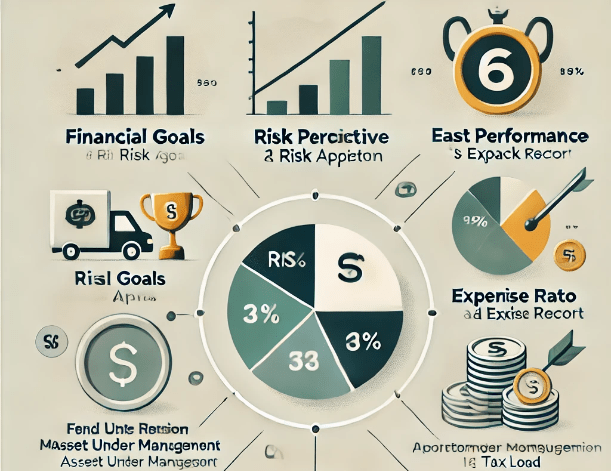
Almost every category of Mutual Funds of dozens of funds available from various Fund Houses. It is not an easy task to select the suitable one for a specific investor. Most retail investor just look at past performance of the fund and select one among the top performance of past few years. However, past performance doesn’t guarantee future good performance. This should be considered as one of the criteria among many. There are lots of examples of fund, whose performance have changed over the years base don various factors. Following are the list of many criteria used by experts to select a MF:
Past Performance
Evaluate the fund’s historical returns over 1 year, 3 years, 5 years, and 10 years.
Compare performance against its benchmark index and peer funds.
Consistency is more important than one-off high returns.
Expense Ratio
A lower expense ratio is preferable, especially for funds with similar performance, as it directly affects net returns.
Fund Manager’s Track Record
Analyze the fund manager’s experience, expertise, industry reputation and performance with other funds they manage.
A skilled fund manager can significantly influence a fund’s success, especially in actively managed funds.
Asset Under Management (AUM)
For niche funds like small-cap or sectoral funds, an optimal AUM size is important.
A larger AUM may indicate trust and popularity, but excessively large funds face many hurdles in investing Midcap or Smallcap funds as the high amount investment from one such fund could move the price of those stocks.
Churn Rate or Portfolio Turnover Ratio
Churn rate, also known as the Portfolio Turnover Ratio (PTR) in mutual funds, measures the extent of buying and selling of securities within a fund’s portfolio over a given period, typically one year. It reflects the level of activity or trading conducted by the fund manager in managing the fund.
High Churn Rate: Indicates frequent trading within the fund, Higher transaction costs. A high churn rate may align with aggressive fund strategies, such as sector rotation or momentum investing.
Low Churn Rate: Indicates a more conservative buy and hold or passive investment strategy with less frequent trading, lower transaction costs.
Portfolio Composition
Most Equity related Mutual Funds publishes their portfolio on monthly basis. Analyzing the portfolio composition provide clear idea about Fund Manager’s style of investing, fund’s allocation across asset classes, sectors, and geographies. Gives an idea on Fund’s diversification and concentration risk.
Tracking Error
This indicates the deviation of a fund’s returns from its benchmark. It is primarily used for Passive Index funds.
High Tracking Error signifies High deviations from the benchmark index and Low Tracking Error vice versa.
Risk Measures
Risk measures are statistical tools and metrics used to assess the volatility, potential losses, and performance of mutual funds. Understanding these measures is essential for selecting funds that align with your risk tolerance and investment objectives. Savvy investors can look at details of all the ratios down below. However, for most retail investors, basic understanding of few key parameters are good enough for selecting Equity related fund.
| Alpha | Beta | Standard Deviation | Sharpe Ratio | Sortino Ratio |
| Fund’s ability to generate returns above its benchmark | Fund’s return volatility compared to Market return | Fund’s return volatility compared to its own average return | Risk-adjusted returns, how much return is earned per unit of risk taken | Variant of the Sharpe Ratio that focuses only on downside risk |
| Positive Alpha: Return over and above the benchmark. | Beta > 1: The fund is more volatile than the market (amplifies gains/losses) | High standard deviation implies higher volatility and risk | Higher Sharpe Ratio: Better risk-adjusted performance. | Higher Sortino Ratio: The fund rewards more for every unit of downside risk. |
| Larger positive value means better returns | Value lower than or close to 1 is good. | Value close to 10 is very good for Equity related fund. | Value above 1 is considered good. | Value of 2 or more is considered very good. |
Conclusion
It is not easy to select a suitable Mutual Fund just based on few years of Historical Returns. Many of the above mentioned factors need to be considered before finalizing on a Mutual Fund on a specific category. Moreover, these factors don’t remain constant for a Mutual Fund, hence all Mutual Fund investment needs Yearly/Periodic/Need Based review and action. You can count on us for using these selection criteria and help you in making the selection based on your investment mindset and profile.
 India Investment Corner
One thought on “How to Choose the Right Mutual Fund: Key Insights”