
There are various types of Factor based investing strategies. There are corresponding Indices created to track those Factor based strategies and associated Mutual Funds and ETFs to invest based on those Factors and follow such Indices. There are even Mutual Funds and Indices, which follow combination of multiple factors together. Let’s try to understand these factor now.
| Investment Factor | Description of stocks in this investment | Financial Parameters | Possible Drawbacks of this strategy |
| Value | Relatively Cheap Stocks in Current Market situation, which can provide better scope of return | Low P/E (Price to Earnings), Low P/B (Price to Book Value) | There are chances that the Company may not have much growth opportunities in future and hence the Market is putting lower Valuation for this stock |
| Growth | Consistently growing Stocks both in terms of Revenue and Profitability, | Stock selection is primarily based on Growth Rate of Revenue and Earnings etc. | Growth stocks are normally expensive. If the current stock price already factors in future growth, there could be possibility of no future return for many years. |
| Quality | Strong Balance sheet , provides high downturn protection | High RoE (Return on Equity), RoCE (Return on Capital), Low Debt to Equity ratio (Means very low or no debt by the company) | The company may have currently strong balance sheet, but future growth potential may be low. In such case, there may not be much future return possible. |
| Momentum | High Demand stock in current market. It is based on Philosophy of “Bhao Bhagawan Che” a Gujarati phrase saying Price is God | Stock price growth in past few months is the primary parameter | There are many stocks which comes to high demand, even without any fundamental growth in their business (Based on sentiments). Such stocks could significantly go down when a market downturn comes. |
| Low Volatility | Relatively stable stock with Low Price Volatility | Low Standard Deviation of Stock Price compared to the standard index | Here also the stocks are picked up based on their price change, not based on any fundamental business parameter. |
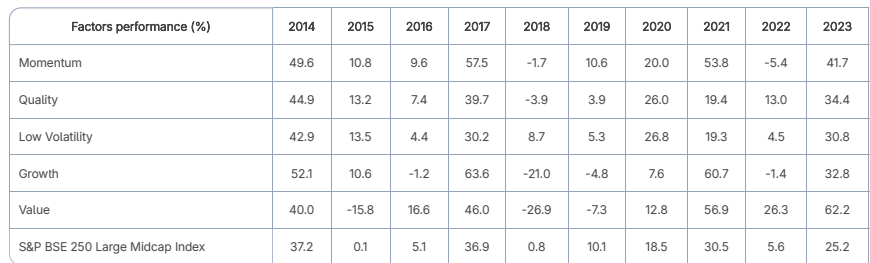
Let’s Look at the historical performance of each of the Factors:
Summary
As you can see none of the strategies returns good all the times, at different years different strategies do better. Also, some strategies dom Much Better than the larger Stock Market in each of the years. However, we can see that the Low Volatility factor definitely helps in providing relatively consistent returns every year. Due to this, there are some additional strategies got created which are Multi Factor strategies that combine multiple factors together. These funds aim to balance Risk and Returns by taking advantage of different market conditions.
Few of the Multi Factor indices from NSE is listed below, there are few mutual funds also following these indices
Nifty Alpha Quality Low Vol 30 :Top 30 Stocks based on Alpha , Quality and Low Volatility factors
Nifty Multicap Momentum Quality 50: Top 50 Stocks from all Market Cap with Momentum and Quality
Nifty Quality Low Vol 30: Top 30 stocks with High Quality and Low Volatility.
Some Multi Factor Mutual Funds
ICICI Prudential Alpha Low Vol 30 ETF
- Index Tracked: Nifty Alpha Low Volatility 30 Index
- Description: This ETF provides exposure to a diversified portfolio of 30 stocks selected based on two factors—alpha (price performance) and low volatility. The objective is to invest in companies that deliver high returns with low volatility.
Motilal Oswal Nifty 200 Momentum 30 Index Fund
- Index Tracked: Nifty 200 Momentum 30 Index
- Description: This fund tracks an index that selects the top 30 stocks with the highest momentum scores from the Nifty 200 universe. Momentum is based on price performance over the past six to twelve months.
UTI S&P BSE Low Volatility Index Fund
- Index Tracked: S&P BSE Low Volatility Index
- Description: The fund tracks the S&P BSE Low Volatility Index, which focuses on selecting stocks that exhibit lower volatility relative to the broader market, aiming to minimize risk while maintaining market exposure.
Nippon India Nifty Alpha Low Volatility 30 Index Fund
- Index Tracked: Nifty Alpha Low Volatility 30 Index
- Description: This fund focuses on stocks that exhibit both high alpha and low volatility, combining momentum and risk management factors for potential outperformance with controlled risk.
SBI Multi Factor Fund
- Index Tracked: Nifty Alpha Quality Low Volatility 30 Index
- Description: This fund tracks the Nifty Alpha Quality Low Volatility 30 Index, which selects 30 stocks based on factors like alpha, quality, and low volatility, providing a diversified exposure to stocks with favorable risk-adjusted returns.
Edelweiss Nifty 100 Quality 30 Index Fund
- Index Tracked: Nifty 100 Quality 30 Index
- Description: This fund tracks an index of the top 30 companies from the Nifty 100 universe based on quality factors like return on equity, financial leverage, and earnings stability, which are key indicators of a company’s long-term performance.
High Performing Multi Factor Investing Index
Nifty 500 Multicap Momentum Quality 50 TRI, which has collection of 50 Stocks from 500 Top stocks selected based on Momentum and Quality, has provided better return compared to other indices on 1, 3, 5, 7, 10 years period (as of September 2024). All details are available HERE
Edelweiss AMC has launched a passive Mutual Fund based on this Index (Edelweiss Nifty 500 Multicap Momentum Quality 50 Index Fund)
 India Investment Corner