Stock exchanges and other agencies have created certain indexes based of certain pre-defined criteria. As the name suggests, Index investing is like putting your investment to follow stock/asset composition of such an Index (Like BSE Sensex or NSE Nifty 50 etc.) and your Investment grows at the same speed at as the Index growth. It is also known as Passive investment.
Key Features and Benefits of Index Funds
Passive Management: Index funds are passively managed, meaning the fund manager does not actively pick stocks. The goal is to replicate the index’s performance as closely as possible.
Lower Costs: Because of passive management, index funds have lower expense ratios (management fees) compared to actively managed funds. This makes them a cost-effective investment option.
Broad Market Exposure: Investing in an index fund provides exposure to a broad range of stocks across different sectors, which reflects the market’s overall performance. For example, a Nifty 50 Index Fund exposes investors to 50 of the largest and most liquid stocks in India.
No Stock Picking Risk: Since the fund merely replicates the index, the risk associated with poor stock selection by a fund manager is eliminated. However, the fund is still subject to market risk.
Returns Aligned with Market Performance: The returns of an index fund will closely follow the index it tracks. When the index rises, the fund value increases; when the index falls, the value declines.
Simplicity and Transparency: Index funds are straightforward to understand because their portfolios reflect the components of a well-known index. Investors know exactly what the fund holds and how it is performing based on the index movement.
Risks of Funds
Market Risk: Index funds are fully exposed to market movements. When the market or the index being tracked declines, the fund’s value will also fall. There is no attempt to mitigate losses during a market downturn, unlike actively managed funds, which may adjust portfolios to limit risks.
No Scope for Outperformance: Since index funds aim to match, not outperform, the benchmark, they cannot generate alpha (excess returns over the index). In strong bull markets, actively managed funds might outperform the index, but an index fund will only provide returns equal to the index minus its expense ratio.
Tracking Error: Index funds may not always perfectly replicate the index due to factors like transaction costs, cash holdings, or minor variations in portfolio composition. This leads to a tracking error, which is the difference between the index returns and the fund’s actual returns. While index funds aim to minimize tracking error, it still exists.
Who Should Invest in Index Funds?
- Long-Term Investors: Index funds are ideal for long-term investors looking for steady growth and willing to ride out market volatility. Historically, markets have delivered substantial returns over longer periods.
- Cost-Conscious Investors: Those who prefer low-cost investment options with minimal management fees and do not require active management or stock-picking expertise should consider index funds.
- Passive Investors: Investors who want market-linked returns but don’t want to actively manage their portfolios can benefit from the simplicity and ease of index funds.
- Beginners in Mutual Funds: New investors with limited market knowledge can start with index funds, as these are easy to understand and provide broad market exposure without the need for in-depth stock analysis.
Universe of Indices in India
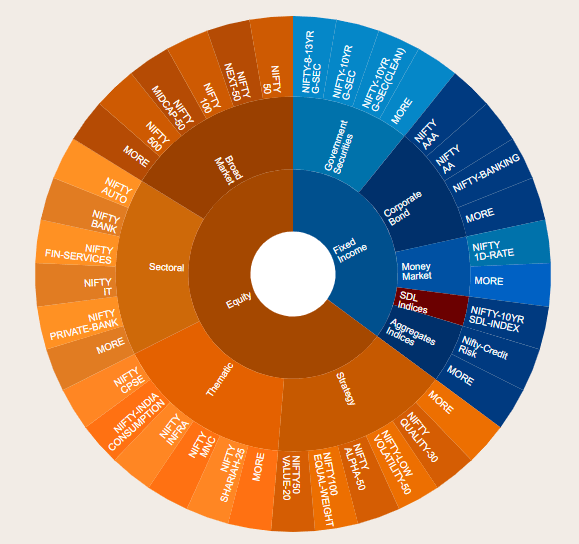
In India both BSE and NSE defined many Indices based on various criteria such as Market Cap/Size of the company, Momentum , Low Volatility etc. and their mixes. There are also Indices related to Sector, Theme, Investment Strategy, Asset Class etc. NSE has created a dedicated website to describe all their Indices and also provide the Mutual Funds and ETFs names with follow those Indices.
NSE Indices from (https://www.niftyindices.com/)
Historical Returns of Indices
Historical performance of most Benchmark indices of BSE and NSE are available at Advisorkhoj website
List of few Popular Index Funds in India
Nifty 50 Index Funds
These funds track the Nifty 50, which consists of the 50 largest companies listed on the NSE.
- HDFC Index Fund – Nifty 50 Plan
- SBI Nifty Index Fund
- ICICI Prudential Nifty Index Fund
- UTI Nifty Index Fund
- Tata Index Fund – Nifty 50
- Axis Nifty 50 Index Fund
- Nippon India Index Fund – Nifty 50
Sensex Index Funds
These funds replicate the performance of the BSE Sensex, which consists of 30 large companies listed on the Bombay Stock Exchange (BSE).
- SBI Sensex Index Fund
- HDFC Index Fund – Sensex Plan
- ICICI Prudential Sensex Index Fund
- UTI Sensex Index Fund
- Tata Index Fund – Sensex Plan
- Nippon India Index Fund – Sensex Plan
Nifty 100 and Nifty 500 Index Funds
These funds track broader indices, giving exposure to the top 100 or 500 companies listed on the NSE.
- Nifty 100 Index Funds:
- ICICI Prudential Nifty 100 Index Fund
- Nippon India Nifty 100 Index Fund
- Nifty 500 Index Funds:
- HDFC Nifty 500 Index Fund
- Motilal Oswal Nifty 500 Index Fund
- ICICI Prudential Nifty 500 Index Fund
Midcap and Smallcap Index Funds
These funds track indices that represent mid-cap or small-cap stocks, offering exposure to smaller, growth-oriented companies.
- Nifty Midcap 150 Index Funds:
- Motilal Oswal Nifty Midcap 150 Index Fund
- ICICI Prudential Midcap 150 Index Fund
- Nifty Smallcap 250 Index Funds:
- Motilal Oswal Nifty Smallcap 250 Index Fund
Nifty 50 Equal Weight Index Funds
These funds track the Nifty 50 Equal Weight Index, where each company in the index is assigned equal weightage.
- Motilal Oswal Nifty 50 Equal Weight Index Fund
- SBI Nifty 50 Equal Weight Index Fund
International Index Funds (Feeder Funds)
These funds invest in international indices, giving Indian investors exposure to global markets.
- Motilal Oswal Nasdaq 100 Fund of Fund (tracks the Nasdaq 100 Index, focusing on U.S. technology stocks)
- Franklin India Feeder – Franklin U.S. Opportunities Fund (tracks U.S. markets)
- Edelweiss Greater China Equity Off-shore Fund (tracks markets in China)
- PGIM India Global Equity Opportunities Fund (invests in global equities)
Sectoral and Thematic Index Funds
These funds track sector-specific indices, offering exposure to particular sectors or themes.
- ICICI Prudential Nifty IT Index Fund (tracks Nifty IT Index, focusing on information technology)
- SBI Banking & PSU Fund (tracks PSU and banking sector)
- UTI Nifty Pharma Index Fund (focuses on the pharmaceutical sector)
- ICICI Prudential Nifty Healthcare Index Fund
- Motilal Oswal Nifty Bank Index Fund (tracks Nifty Bank Index, focusing on banking sector)
 India Investment Corner